
The Midas Touch
What it takes to turn your writing into gold

If you’re a writer, or an aspiring writer, or just a dreamer and highly-sensitive person who thought you might write a bestseller someday, this post is for you.
What goes into writing something a lot of people read?
To be honest, mostly luck.
Case in point: the story of Midas, the king who turned everything he touched into gold.
I’m interested in Midas because I’m a big fan of Nathaniel Hawthorne’s A Wonder Book for Girls and Boys, the first children’s book about Greek mythology.
More about Nathaniel Hawthorne as a (highly-sensitive) INFP in my email newsletter. Subscribe here.
In the Wonder Book, Hawthorne chooses 6 stories from Greek mythology to retell. Among them is the one about Midas receiving the golden touch.
Now if you take a course in Classical Mythology at the university level, I’d wager Midas will not be included in the syllabus.
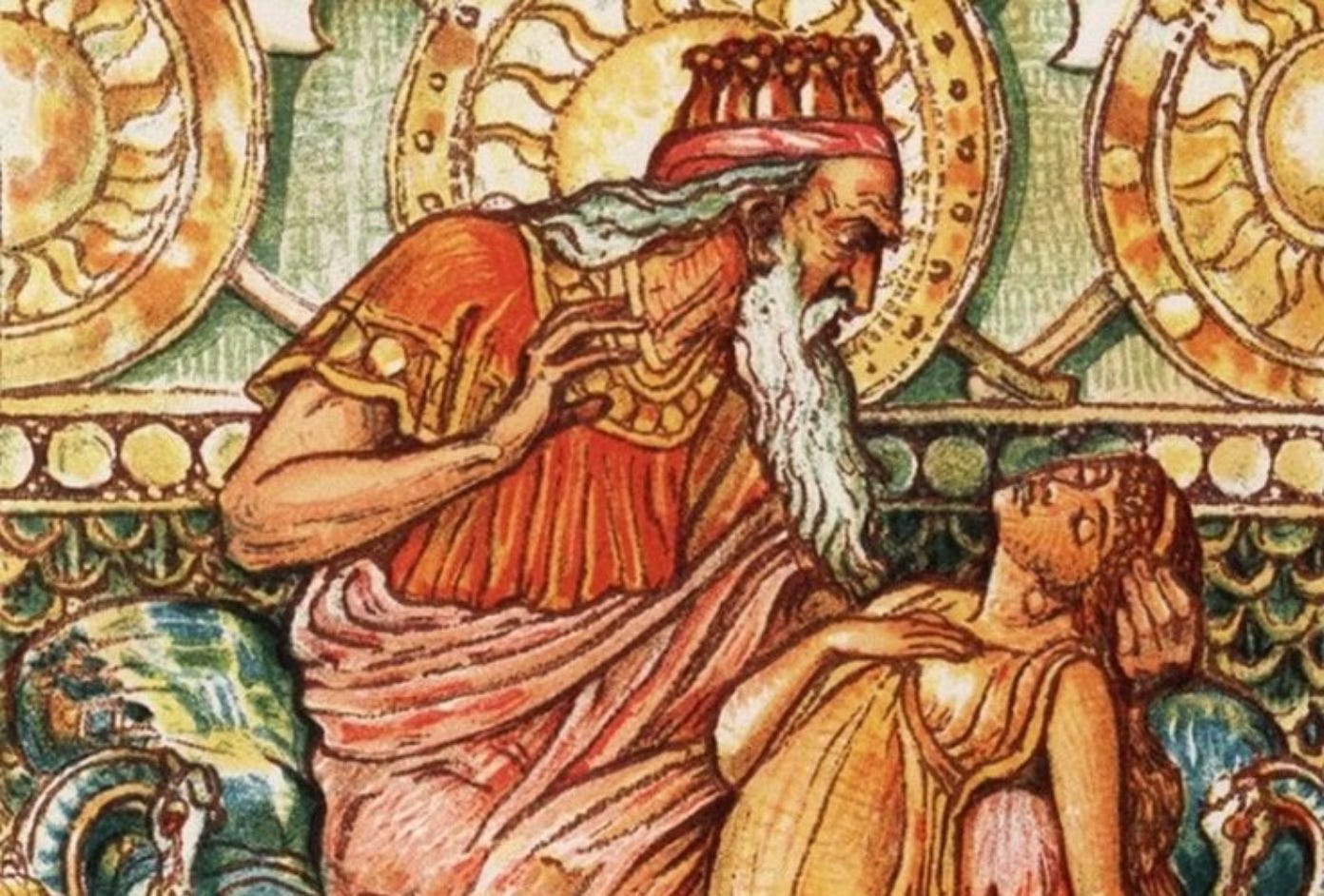
That’s because the Midas story isn’t really Classical Mythology. It’s not in the Iliad or the Odyssey. It’s not the subject of any surviving play. It wasn’t a popular or influential story among ancient Greeks.
In fact, there are numerous odd traditions about Midas which mutually do the opposite of reinforcing each other. He started out, archeology and history tell us, as a historical king of Phrygia, a region in central Anatolia (modern Turkey).
The touch of gold is only one of the many conflicting details in MIdas’s story complex.
No, Midas was not a big player in Greek myths. His tale survived mainly because Ovid, a Roman author writing in Latin, included it in his poem about transformations, the Metamorphoses.
The Metamorphoses was always popular as a source of Greek tales in Europe during the medieval period when ancient Greek was not widely read.
Hawthorne was a voracious reader, and did well at Latin, both in reading and writing it, and he may have picked up on Midas because he had read the Metamorphoses.
But there are dozens and dozens of stories in the Metamorphoses. Why would Hawthorne choose it over any of the others?
(Are you getting the drift here? For us today, even in this internet age, to be able to hear the name Midas and think “golden touch,” even for some of us to remember the eponymous car repair company whose motto was “Trust the Midas Touch,” a lot of fortunate things had to happen.)
I went into the question of Midas’s current popularity with the idea that Hawthorne was solely responsible for it. After all, his book, along with the sequel Tanglewood Tales, became a standard textbook on mythology for elementary schools. Generations of children have heard about Midas because of Nathaniel Hawthorne.
But a little more digging revealed something else.
Kane O’Hara, an eighteenth century Irish playwright, wrote a comic play about Midas that premiered in London in 1764. It followed a tradition at that time of mocking the excessive reverence of the time for things classical, and it was so popular that, according to scholars, the play was “as late as 1870…universally familiar.”
Hawthorne wrote and published A Wonder Book in 1851. Therefore, it’s possible that he knew about O’Hara’s play and never would’ve noticed Midas if it weren’t for that play and O’Hara’s choice.1
Two thousand five hundred years since the first story of Midas was told. Two thousand five hundred years of luck. That’s what went into Midas’s “virality.”
It’s common knowledge that traditional publishers have no idea what is going to sell, even when the book is by a celebrity or a previous bestselling author. They do their best to edit a book and market it as they can, but they really have no control over its performance sales-wise.
For independent authors, since Amazon made it easy to publish e-books and print books on demand, the watchword has always been volume. Writing a lot of books means you get more lottery tickets. The more you publish, the more chances you have of your book hitting. And when your book hits, the logic goes, the rest of your catalogue will sell, too.
For me, and I think for a lot of highly-sensitive writers, that’s a cynical, boring, and ultimately unsustainable way of operating. We don’t look at writing as industrial output. We write from the heart, with passion. We love what we write. We want people to love our writing, too.
Plus, the more books get stuffed into the Amazon machine, the less possible it is that they will ever be found, much less sold.
So here’s the point: if you want to write good stuff, it’s going to take time. You won’t be able to turn out book after book with the hope that one of them will suddenly become The Da Vinci Code.
Instead, it should be empowering and freeing to know that luck governs just nearly all popularity in the storytelling world.
It isn’t about how good the story is. Midas is a good story, but did it deserve to survive and thrive for thousands of years?
It isn’t about how perfect the writing is. Or the plot. Or the characters.
Your book is your gold. What you touch, what you create, is the most precious thing to you.
So write what you like. Publish it if you want. And market it as you can2 That’s the message.
Let luck take care of itself.
Even farther down the rabbit hole: the scholar Hugo McPherson, who wrote the book Hawthorne As Myth-Maker (Toronto 1969), notes that Hawthorne almost certainly used a classical dictionary authored by Charles Anthon to guide his storytelling, and that “it would seem that Hawthorne studied this material rather than any finished version of the Midas story.” That still doesn’t explain why Hawthorne originally chose Midas out of all the stories at his disposal.
I’m still learning about marketing. Let me know if you want to learn along with me.
Just a quick note to say that I launched my own newsletter exactly four years ago -- a big impetus was seeing you post links to your writing via Twitter...I haven't used that app for quite some time, but I still remain grateful for your encouragement!
(Coincidentally, my initial issue also discussed Ovid - although it was in the context of Orpheus rather than Midas)